

The philosopher Karl Jaspers coined the term criminal state (Verbrecherstaat) to describe the Nazi regime, arguing it was not merely that individuals employed by the state who committed crimes, but that the entire state apparatus was mobilized to commit crimes. The political theorist Hannah Arendt expanded on this concept in Eichmann in Jerusalem, arguing that the Nazis transformed the commandment “thou shalt not kill” into “thou shalt kill.”
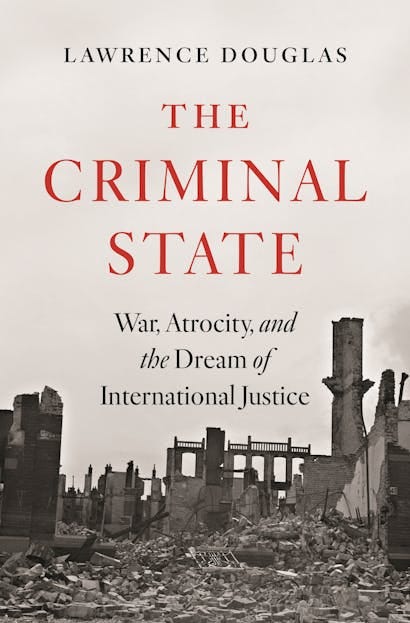
Lawrence Douglas, a professor and legal scholar at Amherst College, is the author of a new book, titled The Criminal State; War, Atrocity, and the Dream of International Justice. He describes how international law has struggled to deal with the specter of the criminal state. He weaves history with political theory and law to trace the shifting legal response to state aggression and atrocities, from Leopold’s rule over the Congo to Putin’s war in Ukraine. He shows how the Nuremberg trials challenged centuries of thought that shielded sovereigns from legal scrutiny. Yet Nuremberg’s bid to frame aggression as the cornerstone of a new order of international criminal law largely failed, giving way to a system now centrally concerned with crimes against humanity and genocide—while leaving unresolved the legality and effectiveness of using force to stop the worst violations of human rights.
In this conversation, Douglas discussed how the crime of aggression has largely fallen by the wayside in international law, amid Putin’s aggressive full-scale war in Ukraine, and wars of choice by U.S. President Donald Trump in Venezuela and Iran.
You are reading Public Sphere, an independent publication which is 100% funded by readers just like you who choose to become paid subscribers. I do not have a paywall today. You can read this site for a week or a month or six months, to see if you like it. Prices are high now, but on a monthly basis, subscribing to Public Sphere annually is about a coffee a month — and it immeasurably helps sustain this project. Cheap!


