
Why Has the U.S.-Israel War Against Iran Killed So Many Civilians?
Much attention has been paid to Trump's apocalyptic threats. But what about what's already taken place?

You are reading Public Sphere, an independent publication which is 100% funded by readers just like you who choose to become paid subscribers. I do not have a paywall today. You can read this site for a week or a month or six months, to see if you like it. If you do—if you think this is a worthwhile place, and you would like to help it survive—I ask that you take a moment to become a paid subscriber yourself.
If you found this post useful, you can use the buttons below to share it:
On April 7, U.S. President Donald Trump made an apocalyptic threat against Iran. “A whole civilization will die tonight, never to be brought back again,” he posted on Truth Social. However, minutes before Trump’s deadline, he announced that the two slides had agreed to a two-week cease-fire, which is set to expire on April 22. However, the threat underscored Trump’s readiness to use extreme violence in the joint U.S.-Israel military operation against Iran.
While the world breathed a sigh of relief that Trump didn’t carry out his threat, the air campaign against Iran has, from the start, exhibited extreme violence against civilians. Information is difficult to gather because Iran’s leaders have shut off the internet and few Western journalists have been able to report from inside the country. However, according to the independent human rights group HRANA, in the 40 days of the conflict, at least 1,701 civilians were killed, including 254 children. The group recorded 1,201 military deaths and 714 additional deaths that it could not classify as military or civilian. (These numbers are all minimums, and the total numbers are likely higher.)
On the first day of the campaign, February 28, a bombing on a girls’ primary school in southern Iran, killing at least 175 people, many of them children. The New York Times analyzed images from the scene that showed fragments from a U.S.-made Tomahawk missile. Trump has claimed without any evidence that Iran did it; a preliminary inquiry by the Pentagon held the U.S. at fault. On the same day as the school attack, a U.S.-made missile hit a sports hall in Iran, killing at least 21 people. The U.S. military initially denied the sports hall attack, but Times reporting confirmed that the missile was American. Later, Iran’s premier health facility, the Pasteur Institute, and its top technical university, the Sharif University of Technology were also bombed.
The military analyst Phillips O’Brien wrote on Substack that the number of casualties in the air campaign has vastly exceeded Russian leader Vladimir Putin’s against Ukrainian civilians in all of 2025. He added that the brutality of the air campaign “is not being acknowledged anywhere...We have normalized many terrible things recently—and deceiving ourselves is one of them.”
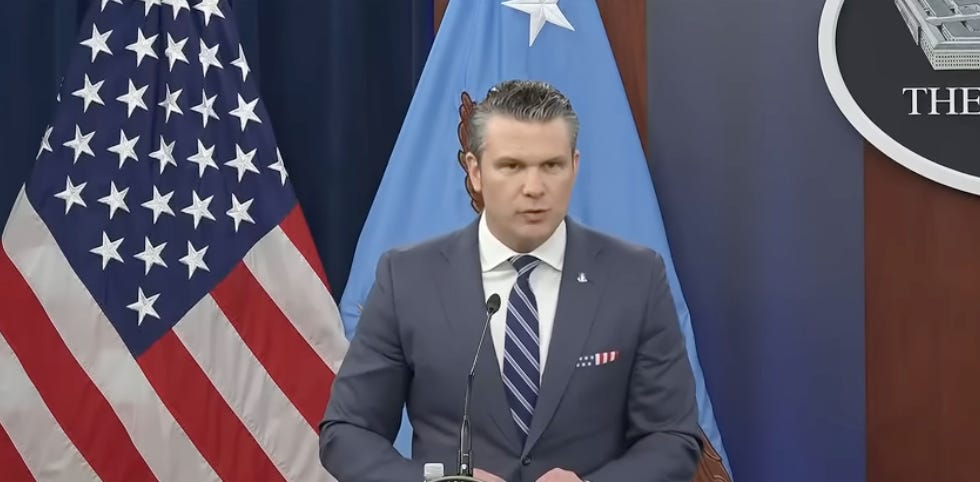
Secretary of Defense Pete Hegseth is claiming two contradictory things about the campaign: that the U.S. has disbanded the laws of war in favor of lethality, and that the U.S. targets with precision. Hegseth said on March 6 that the U.S. does not fight anymore with “stupid rules of engagement.” He has said that the U.S. only targets precise military targets, unlike Iran, which indeed has hit civilian targets in the Gulf, like luxury hotels in Dubai. On April 16, he said, “We only target military targets.”
Under Trump, the U.S. has done away with Pentagon initiatives to reduce civilian casualties. ProPublica reported that Trump’s DoD axed the Civilian Protection Center of Excellence, created under President Joe Biden to reduce the harm done by U.S. strikes. Sarah Yager, who was a civilian protection advisor to the chairman of the Joint Chiefs during the first Trump administration and now is Washington Director at Human Rights Watch, wrote of the Iran war, “I know what it looks like when civilian protection works. This isn’t it.”
Reducing civilian casualties is not a matter of “political correctness,” as Hegseth has claimed. There are moral, strategic, and legal reasons to reduce civilian casualties. The moral reasons are obvious. From a strategic perspective, recklessly killing civilians undermines the Trump Administration’s initial goal of regime change, as it alienates the very people that are supposed to overthrow Iran’s theocratic government, which itself killed an estimated 7,000 civilians in protests in January. As Gen. Stanley McChrystal observed in Afghanistan, recklessly killing civilians is counterproductive: he coined the concept of “insurgent math,” which holds that, for every innocent civilian killed, ten new insurgents are created.
Legally, the U.S. may be opening itself up to war crimes charges. Even if the targets are not intentional, recklessness is a standard in international humanitarian law, just as a drunk driver can be charged with manslaughter even if he had no intent of killing another person. Akshaya Kumar, crisis advocacy director at Human Rights Watch, wrote in Lawfare: “If U.S. forces failed to take the necessary measures to avoid civilian casualties…they could be considered in violation of international humanitarian law (IHL)—and, if individuals acted sufficiently recklessly, they may be guilty of a war crime.” (Strikes against legitimate military targets that incidentally kill civilians are not war crimes, provided all feasible precautions are taken.)
In his April 16 press conference, Hegseth repeated Trump’s threat of attacking Iran’s civilian infrastructure if the cease-fire fails after its expiration next week. This could amount to war crimes. Even if Trump doesn’t make good on its threat, the U.S. conduct to date should prompt a reckoning about its moral and legal obligations in fighting wars -- but it’s barely a topic of discussion.
Thanks for reporting on this- dismaying that the wanton killing of civilians is getting so little coverage and, as you say, is being normalized.