
Trump's 'Peace is at Hand' Moment
Why a 'largely negotiated' deal is on the ropes

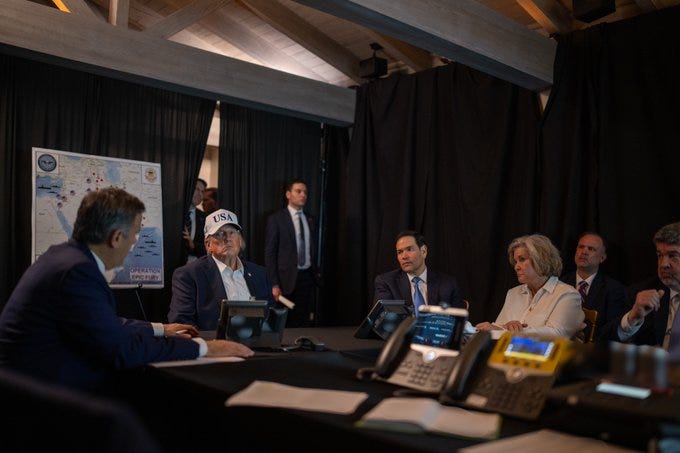
On May 23, U.S. President Donald Trump posted on social media that a peace deal with Iran was “largely negotiated” and that a memorandum of understanding would be announced “shortly.” Five days later, no agreement has been announced and the U.S. and Iran have traded tit-for-tat strikes in the Strait of Hormuz, demonstrating that Tehran can still threaten the vital waterway, where about 20 percent of the world’s oil supplies once flowed through. After Republican senators pushed back on a deal that might leave Iran in control of the strait, Trump backpedaled and said, “if I make a deal with Iran, it will be a good and proper one, not like the one made by Obama,” referring to the 2015 agreement made by his predecessor, which he withdrew from in 2018.
Trump keeps favorably comparing the Iran war to the Vietnam War, saying that the former is short by comparison. (However, Trump initially said that the Iran war would last between four to six weeks, and it has lasted longer than two months.) The comparison is apt -- but not in a way that is favorable to Trump. The U.S. eventually stopped fighting in Vietnam because it had no strategy for winning and even with a superior military, it couldn’t stay indefinitely; all the communist North Vietnamese regime had to do to win was not to lose. Similarly, even the mighty U.S. has limited military resources; all Tehran has to do is not lose.
Trump’s Saturday declaration that an agreement was “largely negotiated” seemed to echo National Security Adviser Henry Kissinger’s infamous comment a week before the November 1972 presidential election that peace in Vietnam was “at hand.” U.S. President Richard Nixon then won in a landslide, but it took another three months -- and brutal bombings that changed nothing on the ground -- before the administration hammered out a deal where the U.S. withdrew its forces, leaving the allied South Vietnamese government defenseless to resist an invasion by the North, which happened some two years later, handing the U.S. a defeat.
Trump’s zigzagging over ending Operation Epic Fury which he started on February 28 with Israel illustrates an unavoidable problem that also echoes Vietnam: Trump can’t exit the war in a better place than he started it.
