
Trump Wanted Iran's 'UNCONDITIONAL SURRENDER.' He's About to Settle for Much Less.
The emerging MOU offers little more than a cessation of hostilities for a war that has achieved none of its goals

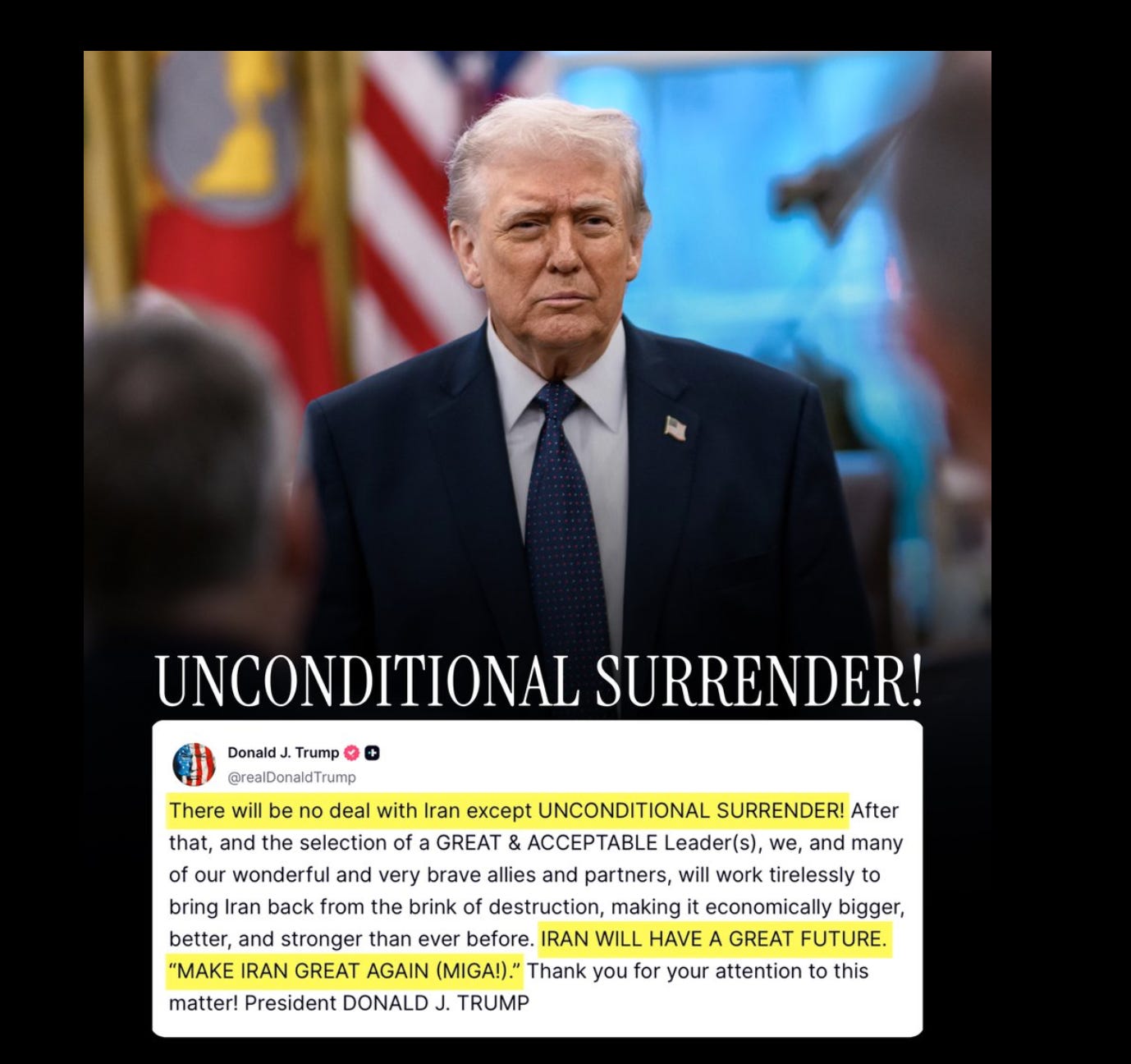
On March 6, U.S. President Donald Trump said, “There will be no deal with Iran except UNCONDITIONAL SURRENDER!” Some 15 weeks later, the United States and Iran are nearing a memorandum of understanding (MOU) to extend the April 7 ceasefire that falls well short of this goal, and would leave Tehran’s regime in a stronger position than when the U.S. and Israel began joint military operations on February 28.
To borrow Trump’s oft-used diplomatic phrase, Iran has the cards in this negotiation. After Israeli airstrikes killed Iranian Supreme Leader Ali Khamenei on the first day of the war, the remaining Iranian leadership withstood a 37-day bombing campaign, and thus is in no mood to compromise. Meanwhile, Trump has no viable military options left that don’t involve putting U.S. troops on the ground, which he does not want to do.
The details of the peace agreement remain murky. However, according to Iranian and U.S. officials, the MOU includes a 60-day ceasefire including Lebanon, the reopening of the Strait of Hormuz and lifting of U.S. and Iranian blockades, and a pledge to continue negotiating Iran’s nuclear program. Iran also says that the U.S. will agree to waive oil sanctions during the negotiation period, and that some $25 billion in frozen assets will be released. Trump denies the latter; however, it’s hard to see Tehran agreeing to a deal without their release. The emerging agreement also contains none of the initial U.S. and Israeli goals of containing Iran’s ballistic missile program and reducing Iranian support for its regional proxies, such as Hezbollah in Lebanon and the Houthis in Yemen.
The MOU would allow Trump to claim that the war is over, but not much else. Looking at each of the points of the emerging MOU and the status quo before the war, Iran comes out ahead.
Beyond the paywall, I will address three questions:
Will Iran be economically stronger even if it does not charge tolls or service fees for the Strait of Hormuz?
Will the U.S. have less leverage against Iran’s nuclear program than under the 2015 Obama nuclear deal?
Could Israeli Prime Minister Benjamin Netanyahu scuttle an agreement between the U.S. and Iran?
