
Trump Appeases North Korea as It Steps Up Its Aggression Against Ukraine
Kyiv says that Kim Jong Un delivered ballistic missiles for Russian use in Ukraine. Trump curtailed a major military exercise and touted his 'GREAT' relationship with Kim Jong Un.

On August 14, North Korea issued a typical threat ahead of a major U.S.-South Korean military exercise. “It is our consistent principle of ensuring security to respond to a new level of a threat with a new level of a deterrent,” the statement said. North Korea “will more clearly express its stance on the enemies to cope with any threats and challenges through the responsible and decisive exercise of the right to legitimate self-defense.” This was standard fare, as Pyongyang often uses planned military exercises as excuses to test ballistic missiles and ramp up its weapons production.
In a social media post on August 16, U.S. President Donald Trump gave in to the threat and decided to curtail the exercises. “Based on the fact that it is too late to cancel, I have instructed Secretary of War, Pete Hegseth, to substantially reduce the Joint Military Exercises!” he wrote. He cited his “very good relationship” with North Korean dictator Kim Jong Un as a reason to cut back on the exercises and echoed Pyongyang’s language that the exercises send a “signal that is totally inappropriate and hostile.” Further, he added that “as long as Donald J. Trump has been President, [North Korea] has been unthreatening and respectful.”
Many Ukrainians would likely disagree that the country has been “unthreatening and respectful” during Trump’s presidency. Since 2022, North Korea has supplied missiles and arms on behalf of Moscow in its war in Ukraine, as well as deploying soldiers to Russia in an unprecedented foreign deployment for the hermit kingdom. Ukraine has estimated that in 2024 and 2025, North Korea supplied half the munitions Russia used at the front. In recent days, Kyiv has said that Pyongyang is ramping up its deliveries of troops and ballistic missiles. Ukrainian and Western intelligence agencies believe that North Korea is planning to send an additional 30,000-50,000 troops to Russia. On August 10, Ukraine claimed that North Korean ballistic missiles were used in an attack on the southern city of Zaporizhiya, killing seven and wounding at least 24.
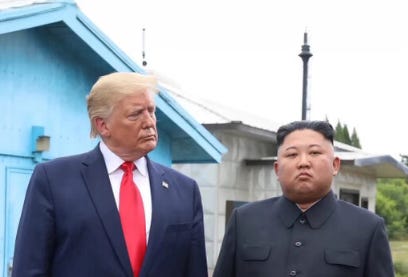
In a press conference last week, a U.S. military spokesman, Col. Ryan Donald, said the exercise will serve as an opportunity to strengthen the U.S.-South Korean alliance, incorporating “lessons from recent conflicts.” “DPRK soldiers have been deployed and fought in Ukraine and they’ve taken those lessons they learned there and brought them back to North Korea,” he said, using the abbreviation for North Korea’s official name. “That changes the DPRK capability and our training accounts for that threat.” On the other hand, Trump, about 24 hours before announcing the reduction of the exercises, posted a 2019 picture of himself and Kim, saying that while the two had an “unfriendly look” in the photo, the pair “get along GREAT!”
Had the exercises gone ahead as planned as they have during most summers in the past 70 years, it’s likely that they would have generated few headlines. North Korea might have responded with a provocative test, as it often does anyway. (Trump suspended them entirely in 2018, also saying that they were “provocative.”) However, scaling back the exercises gives Pyongyang a green light to escalate its aggression against Ukraine and continue to threaten its neighbors. Moreover, while Trump is throwing non-nuclear democratic allies in Seoul and Kyiv under the bus, he has repeatedly cited his good relationship with their aggressors -- nuclear-armed autocrats in Moscow, Beijing and Pyongyang.
In his missive, Trump complained that Seoul had said “No thanks!” to join in the “Denuclearization of the Islamic Republic of Iran.” Seoul responded that the South Korean government had “actively participated” in international talks aimed at reaching a ceasefire in Iran and was in close consultation with the U.S. “regarding practical and military contributions.” Trump’s complaint showed his tendency to deflect blame for his war of choice in Iran -- which is sucking up critical interceptor missiles that would have been used to protect Asian allies or defend Ukraine -- onto allies that weren’t consulted beforehand. More broadly, by siding with nuclear states in their aggression against non-nuclear democracies, Trump is signaling to traditional U.S. allies in Europe and Asia that Washington won’t defend them anymore, and the only way to protect yourself is to get nukes.
Hey, I’m Luke Johnson, a journalist based in Berlin, and the author of Public Sphere, which offers news and analysis of global affairs to help you make sense of a crazy and dangerous world. I paywall about half of my content, but today I’m giving away this post for free because I want it to reach a lot of people.
This is an independent publication which is 100% funded by readers just like you who choose to become paid subscribers. You can read this site for a week or a month or six months, to see if you like it. If you do—if you think this is a worthwhile place, and you would like to help it survive—I ask that you take a moment to become a paid subscriber yourself. A yearly subscription costs just about $1.34 per week and you will be helping reliable information grow amid a torrent of A.I. slop and authoritarian lies.
If you have questions, comments, or suggestions, message me.
I’d also love a like or share on social media if you found this post useful!
Paid subscribers can comment and join the conversation.