
The Mistake That Western Commentators Make When Analyzing Putin
Many seem to assume the Russian leader lives in the same information space as the rest of us. He does not.

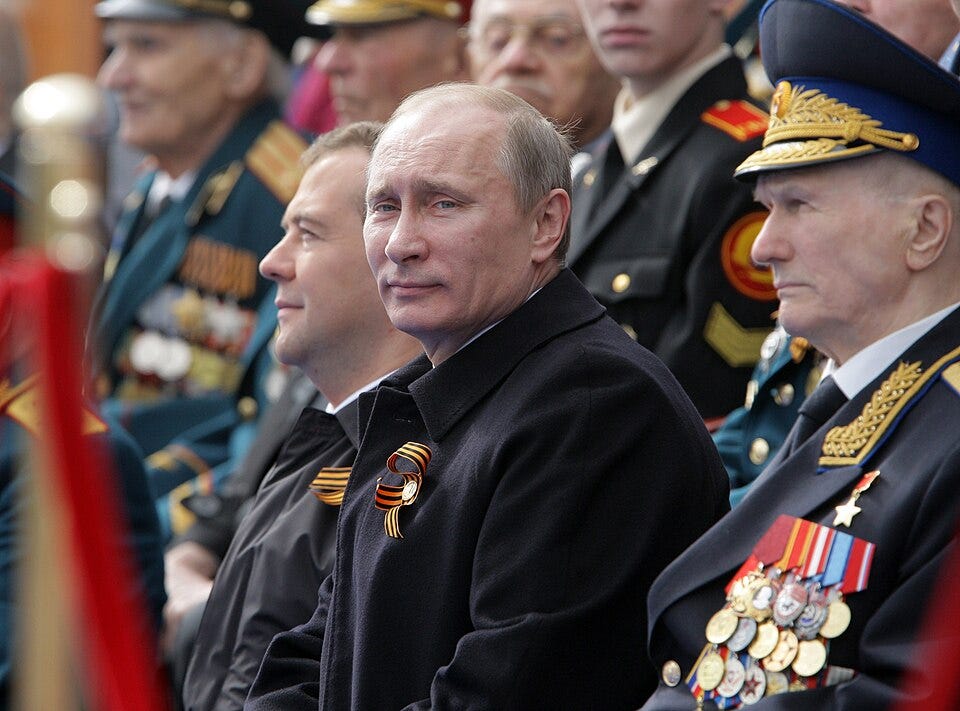
During the scaled-back Victory Day parade in Moscow on May 9, Russian leader Vladimir Putin suggested that the war in Ukraine may be “coming to an end.” The remark indicated to some Western commentators that Putin might be looking for a way out. Simon Saradzhyan, who leads the Russia Matters project at the Harvard Kennedy School, said on X it was the “strongest signal he has sent so far that he wants to end the war soon.” Other reporters and analysts on X indicated that they thought it was a sign that Putin wanted to end the conflict, maybe even with a cease-fire beyond the three-day one that he had asked Trump for to protect the parade, which had no military hardware for the first time in 20 years.
However, a closer reading of the transcript shows that this was not a peace signal, and Putin’s demands for a victory remain unchanged. Elsewhere in the exchanges with Kremlin-friendly journalists, he said that the reason the parade was scaled back was to focus on the “decisive defeat of the enemy in the context of the Special Military Operation.” His comment about the war in Ukraine possibly “coming to an end” was in a long tract about how, in his view, “globalist elites” had broken promises not to expand NATO into former Eastern bloc states after the Soviet Union collapsed. This was another formulation of Putin’s desire that the war end only with a settlement of its “root causes:” the byzantine list of demands that would reverse the Soviet Union’s loss of its empire in Eastern Europe after the U.S.S.R. collapsed in 1991.
On May 9, Putin also suggested that former German Chancellor Gerhard Schroeder could serve as a European representative to end the war and renegotiate the continent’s security architecture. This idea is ludicrous: Schroeder is a pariah for his pro-Russian sympathies. After being defeated in 2005, Schroeder was paid nearly $1 million a year by Russian energy companies and has never fully condemned Russia’s invasion of Ukraine. (He stepped down from his advisory role a few months after the full-scale invasion.) Unsurprisingly, the EU quickly rejected this idea.
In any event, after the three-day U.S.-brokered cease-fire ended, Russia launched its largest drone and missile barrage ever at Ukraine lasting two days, killing at least 27 people. That alone should cause doubt to anyone that Putin wants the war to end. But the interpretations point to a broader pitfall that many Western commentators face when trying to analyze Putin: they think that he is getting the same information as they are. He is not.
For example, Russia wants full control of the Donbas region of Eastern Ukraine, where Kyiv has its strongest defensive fortifications. According to a recent article in the New York Times, this conquest would take Russia over 30 years at its current rate of advance. However, according to the Financial Times, Russian military leaders promised Putin that they could take Donbas by this fall. Of course, the latter timeline is absurd, but it is what Putin is being told, and it’s highly doubtful that anyone brought the Times article to his desk.
