
The Dispensable Nation
Trump loses control of the Middle East and Eastern Europe

In 1998, Secretary of State Madeline Albright said that the United States was the “indispensable nation.” Not only could the U.S. defend itself with its formidable military power, Albright said, but with a web of alliances and a capable diplomatic corps, the U.S. could maintain global peace and security. Diplomacy, military power, and alliances were all more powerful in concert, Albright believed: in other words, the threat of military force was stronger because of alliances, and diplomacy was more stronger because it carried the threat of military force.
In his second term as U.S. president, Donald Trump has sidelined the diplomatic corps and torn up alliances, while its military power has failed to dislodge a weakened regime in Tehran. Diplomats with lifelong language and regional expertise have been replaced by Trump’s envoys, former real estate developer and Trump golf partner Steve WItkoff and the president’s son-in-law, Jared Kushner, who maintains a web of private business interests. The U.S. still has the world’s largest military, but as the Iran war has shown, the Trump Administration has confused means with ends: showing technological prowess in the Iran war has not made up for the lack of strategic goals in starting the conflict. Trump has berated traditional U.S. allies in Europe for not helping reopen the Strait of Hormuz, while also maintaining that he doesn’t need their help. European and Asian allies are now de-risking from the U.S. by pursuing strategic autonomy and greater cooperation among themselves.
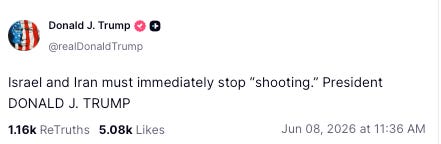
These trends have led the U.S. to become, well, dispensable. This dispensability is evident in the wars in the Middle East and Ukraine, where U.S. allies have ignored Trump’s demands. Over the weekend, Iran launched missiles at Israel for the first time in two months, threatening the cease-fire that Trump announced in April. Iran said it was retaliating against Israeli attacks against the Iran-backed Lebanese militia Hezbollah, which has rejected the cease-fire; Israel has said its war in Lebanon is not part of the cease-fire. According to Axios, Trump told Israeli Prime Minister Benjamin Netanyahu not to retaliate against Iran; Trump told the Financial Times, “I call the shots. I call all the shots. He (Netanyahu) doesn’t call the shots.” However, the possibility of Iran having a deterrent against Israel’s military campaign in Lebanon was intolerable, so Netanyahu promptly retaliated with airstrikes. On June 8, Trump called on both sides to cut it out: “Israel and Iran must immediately stop ‘shooting,’” he posted on Truth Social. Both sides seemed to be moving towards de-escalation on June 8, but only after Netanyahu rejected Trump’s first entreaty, and the structural problem remains: if Israel attacks Hezbollah in Lebanon again, then Iran will retaliate against Israel.
The U.S. has also become mostly dispensable in Ukraine, where Trump promised during his campaign to end Russia’s war in “24 hours.”
The rest of this story is for paid subscribers only. Unlike global oil prices, my subscription rates have not gone up AT ALL. A yearly subscription to Public Sphere is only $1.35 per week; please consider upgrading your subscription to help me continue offering analysis and reporting on global affairs.
