Q&A: Journalist Anand Gopal Tells the Story of a Democratic Experiment in Syria
How a city overthrew Assad, and then tried to build a democracy from scratch

Anand Gopal is a writer for The New Yorker covering wars, revolutions, and democracy. He is the author of a new book, Days of Love and Rage: A Story of Revolution. Based on seven years of research and over 2,000 interviews, the book follows six Syrians and their experiences in the city of Manbij during the Syrian revolution. Gopal also wrote a book about the Taliban in Afghanistan, No Good Men Among the Living, and has reported throughout the Middle East and conflict zones for publications including The Atlantic and the New York Times Magazine. Gopal and I spoke last week. Our conversation follows, condensed and slightly edited for clarity.
Luke Johnson: Can you talk about the city of Manbij and how you came across it?
Anand Gopal: I had been reporting on various conflicts including Iraq and Afghanistan for several years, and in 2011, I was covering the Arab Spring and the Syrian civil war. I was interviewing people who had suffered from airstrikes committed by the Syrian regime, kidnappings, and the proliferation of militias -- stories of destruction and devastation. In the midst of this, I heard about a city named Manbij, which is in northern Syria and has a population of about 200,000 people. They had managed to overthrow the dictatorship in their city and tried to build a democracy from scratch. I was very intrigued to see how that would look, especially in the context of one of the world’s deadliest civil wars.
LJ: Before the Assad regime fell in 2024, journalists were routinely taken hostage and killed in Syria. Can you explain how you have been able to travel to the country and do your reporting?
AG: The first time I went, I snuck into the country under a fence between Turkey and Syria in the middle of the night, as that was the only way to get in. At that point, the Assad regime was controlling most of the country, and there were just a few hamlets that were controlled by protesters. We met some protesters at the border, and they smuggled us in. Eventually, the protesters were continually shot at by the regime, and they militarized. Armed factions began to appear, and these factions seized a few border crossings between Turkey and Syria. Then, one was able to go through these border crossings. Over time, it became more and more difficult to get into the country, in part because the Assad regime reclaimed large parts of territory. In reporting on this book, I had to go through Iraq, and then make a 15-hour drive across the Iraqi border, through Syria, to get to Manbij.
“This story tells us less about Syria, and more about democracy and authoritarianism.”
LJ: So when you got to Manbij, what did you find?
AG: I first arrived in 2016 after the democratic experiment had finished, but I tried to track down people who had been involved in it. A team of researchers and I did over 2,000 interviews with people from the city in the 18-month period beginning in July 2012 when they tried to build a democracy.
LJ: How did this window emerge for a democracy?
AG: During the Arab Spring between 2011-2012, there were protests around the country, and the Assad regime was trying to suppress them everywhere. The government forces were shooting at protesters. Manbij was one of the cities that had a protest movement, and the protesters were shot at, but the regime was simply unable to suppress all of these uprisings simultaneously. Assad’s forces were forced to withdraw from the city. Almost overnight, there was no government: the mayor’s office was empty and Assad’s forces had taken the money from the bank. The protesters formed what they called a Revolutionary Council to take power in the city and to begin to think about how to run the city.

LJ: Myself and I think most of the people reading this interview have never been to Syria, yet they’re concerned about the state of democracy in Europe and the United States. Are there any lessons we can learn from this democratic experiment?
AG: Absolutely. The reason I was drawn to this story is because in a way, it tells us less about Syria, and more about democracy and authoritarianism. In the 18 months that the city was run by this Revolutionary Council, there were two ideas of freedom. There were believers in freedom, which for them, meant freedom of speech, freedom of assembly, and also freedom of markets. However, there began to be an affordability crisis. The cost of food started to rise. Rents were rising because the population was increasing from displaced people from outside the city. There began to be clamoring from working-class people demanding price controls, rent control, and more progressive taxation.
There began to be a divide in the city between these two different conceptions of freedom: the freedom to be left alone, which was being put forward by the leadership, and another kind of freedom, which was the freedom to be given the things you need to live your best kind of life.
Into that divide, a far-right group, ISIS (the Islamic State), inserted itself and began to wage what was essentially a populist campaign, saying that the leadership of the revolution were out-of-touch elites that didn’t care about the needs of ordinary people. They began to promise to working-class people that they can deliver them from their anxieties, and they connected their vision to an extreme version of Islam. They used a lot of distortion; they lied; they were duplicitous. But in everything they did, there was a kernel of truth in their messaging, which was that ordinary people were suffering from unbridled free-market policies. The elites in the city refused to take this seriously until it was too late.
LJ: And how was ISIS ousted?
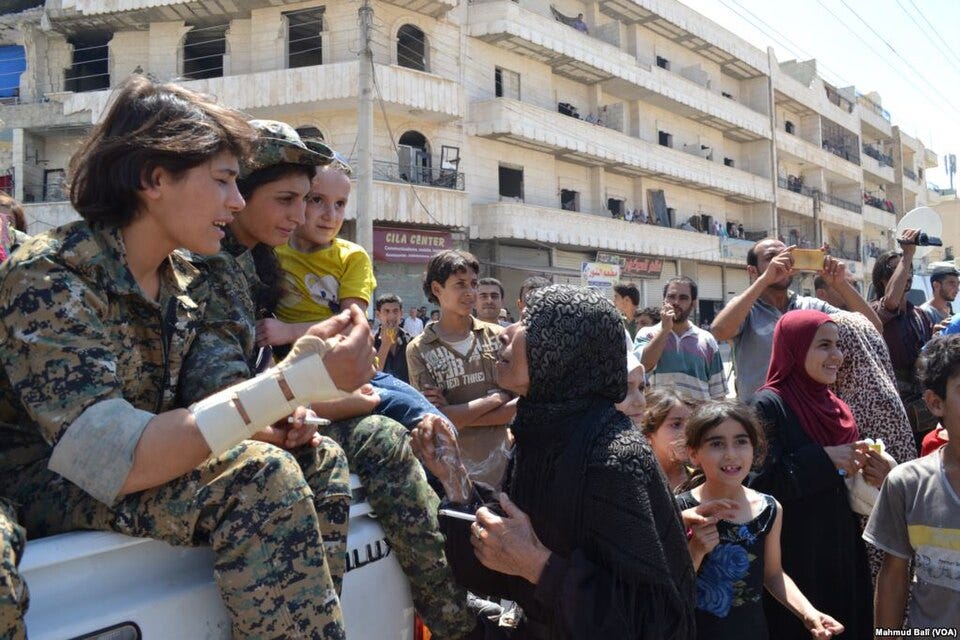
AG: In 2016, the U.S. supported a group of Kurdish-majority fighters called the Syrian Democratic Forces, who invaded the city, destroyed half of the city, killed lots of people, and ultimately ousted ISIS.
LJ: You interviewed a lot of people. Can you talk about somebody who you got to know very well, Abel Os?
AG: Abel Os was a shopkeeper who was also very adept at Karate--that was his sport. Growing up from a very poor family in Manbij, he had grown up with the promise that many Syrians grew up with, which is that if you work hard and play by the rules, that your children will have a better life than you have. For a couple of generations in Syria, that was actually true, even under the dictatorship of Hafez al-Assad, the father of Bashar al-Assad. The promise of Syria -- and across the entire Middle East -- was that the regime will give you basic economic security. In exchange for that, you have to surrender all political rights.
For Abel Os’ father, that meant moving from very poor to being lower-middle class. However, by the time Bashar al-Assad came to power in 2000, the state-supported economic policy was scrapped for a free-market approach. As a result, the cost-of-living started to rise, and Syrians’ ability to imagine a better life for their children compared to themselves vanished.
Abel Os is an example of this. He became a roadside vendor and then opened up a little shop in the city, and he was trying to make ends meet. He ended up having to take out lots of loans. He got himself in debt with loan sharks, and ultimately, he found himself bereft of the shop and he was forced to work as a migrant worker in Lebanon. When the Arab Spring started in 2011, he was at the front lines of the protests, because he didn’t see a future for his or his children’s life under Assad. He then became a leading revolutionary figure in the city during the 18 months.
LJ: How did you get to know him?
AG: I first met him when I started researching the book in 2016, and I got to know him very well over the next several years. We would meet about every two months, and he told me his life story. After becoming the leader in the democratic period, ISIS took over the city, and he was imprisoned by ISIS and suffered greatly in prison. I met him shortly after he was released from prison and ISIS had collapsed, and so he still had those memories fresh with him.
“When civil society, unions, and media don’t exist, it’s as if some essential part of our own human nature has been stifled.”
LJ: You didn’t get to meet everyone. There’s a character in your book, Oday, who goes missing, but you were able to talk to his family members and friends. Can you tell the story of what happened?
AG: Oday threw himself into the protests and became one of the leaders of the protest movement. He was arrested by the Syrian regime and brutally tortured through the course of the 18-month democratic experiment, and he was one of the activists who tried to hold the Revolutionary Council to the promises that they had set forth about freedom and democracy. When ISIS took over the city in 2014, the democratic experiment was dead. But there were some revolutionaries who still wanted to keep fighting, and Oday is the leader of that group. He led a resistance against ISIS. He organized a general strike, I believe, the only example of mass civil disobedience against ISIS anywhere, and it was successful in that the strike shut down the city. But Oday was arrested after the strike, and imprisoned in 2014. By the time I arrived in 2016 after ISIS had fallen, I talked to Oday’s parents, and he was missing. His parents believed that he was being kept somewhere in the desert.
In looking for him, I realized that there’s a much broader story. In the Syrian War, 600,000 people were killed, and around 100,000 people went missing. Their families are still waiting to hear from them. They still believe their loved ones are out there. And in searching for him, I found that there’s many other people in the same circumstance.
LJ: Can you talk about the role of women in this revolutionary government?
AG: Manbij is a fairly conservative, even tribal city. In the book, I profiled a woman, Mina, who was a housewife, and never thought much about politics--she was vaguely supportive of the Assad regime. But her brother got involved in the protests, and he was arrested and tortured. This switched something in her, and she wanted to take a stand. She led a group of women to start protesting against the regime. Once the regime was overthrown in the city and the democratic period began, she realized that her struggle was on two fronts. On the one hand, it’s against the Assad regime and its remnants, but on the other hand, it’s also against prevailing patriarchal attitudes. She created a group called the Women of Freedom, which is fighting to combat sexism in the city, as well as to further the goals of the revolution and democracy. This is just one example of several women’s groups that appear in the revolution, and all of them are fighting this two front battle, sometimes against their own husbands, brothers, and fathers as well as the regime.
LJ: You write:
International law does not consider the slaughter of Syria a genocide, because people were primarily targeted for their political activity--something we normally understand as a free choice…but putting it this way seems to miss something important about the human condition.
What does it miss?
AG: We tend to think of genocide as the worst possible crime because it targets people based on their ethnicity or religion, which people don’t choose. But there are many other instances in history where people have been slaughtered en masse, for example, the killing of leftists in Indonesia. In international law, that’s usually not considered a genocide. It’s not the crime of all crimes.
Syria is a similar case where up to 600,000 people were killed. But it’s not considered a genocide, because the people who were killed were targeted because for their opposition to the regime. Manbij shows that, one day the government collapses, and the next day, people come out and create all these assemblies, newspapers, and councils. They didn’t do it because they were political theorists, but because people have to cooperate to secure the essentials, like bread, electricity, and water.
In the book, I draw on Aristotle for a definition of what politics is. Politics is the art of collectively making alliances to pursue the goods that are needed for life. In that definition, civil society, unions, media, are needed and humans have no choice but to form them when given the chance, and when these things don’t exist, it’s as if some essential part of our own human nature has been stifled.
LJ: What is life like for the people whom you profiled now?
AG: Abel Os unfortunately passed away before the Assad regime fell. Mina is in exile in Turkey. She has not come back to Syria yet, even though she’s thrilled that Assad is gone, but she lived through the overthrow of the dictator in her own city for a year and a half, and saw all of these grand promises that ultimately didn’t come to fruition. She is waiting and wants to know: what will the economic policy be? Will there be jobs for her kids? However, I also profiled someone named Ibrahim, who was a son of a farmer and then became a rebel fighter. He lives in Manbij, and he has a lot of optimism. He feels like now, for the first time, there’s a future for him and for his family. Regardless, the overthrow of the dictator was a great victory for all of them.
You are reading Public Sphere, an independent publication which is 100% funded by readers just like you who choose to become paid subscribers. I do not have a paywall today. You can read this site for a week or a month or six months, to see if you like it. If you do—if you think this is a worthwhile place, and you would like to help it survive—I ask that you take a moment to become a paid subscriber yourself.
If you found this post useful, you can use the buttons below to share it: