
Iran: America's First Post-Reality War
Not even 'truthiness' does justice to Trump's military 'excursion' in Iran

You are reading Public Sphere, an independent publication which is 100% funded by readers just like you who choose to become paid subscribers. I do not have a paywall today. You can read this site for a week or a month or six months, to see if you like it. If you do—if you think this is a worthwhile place, and you would like to help it survive—I ask that you take a moment to become a paid subscriber yourself.
If you found this post useful, you can use the buttons below to share it:
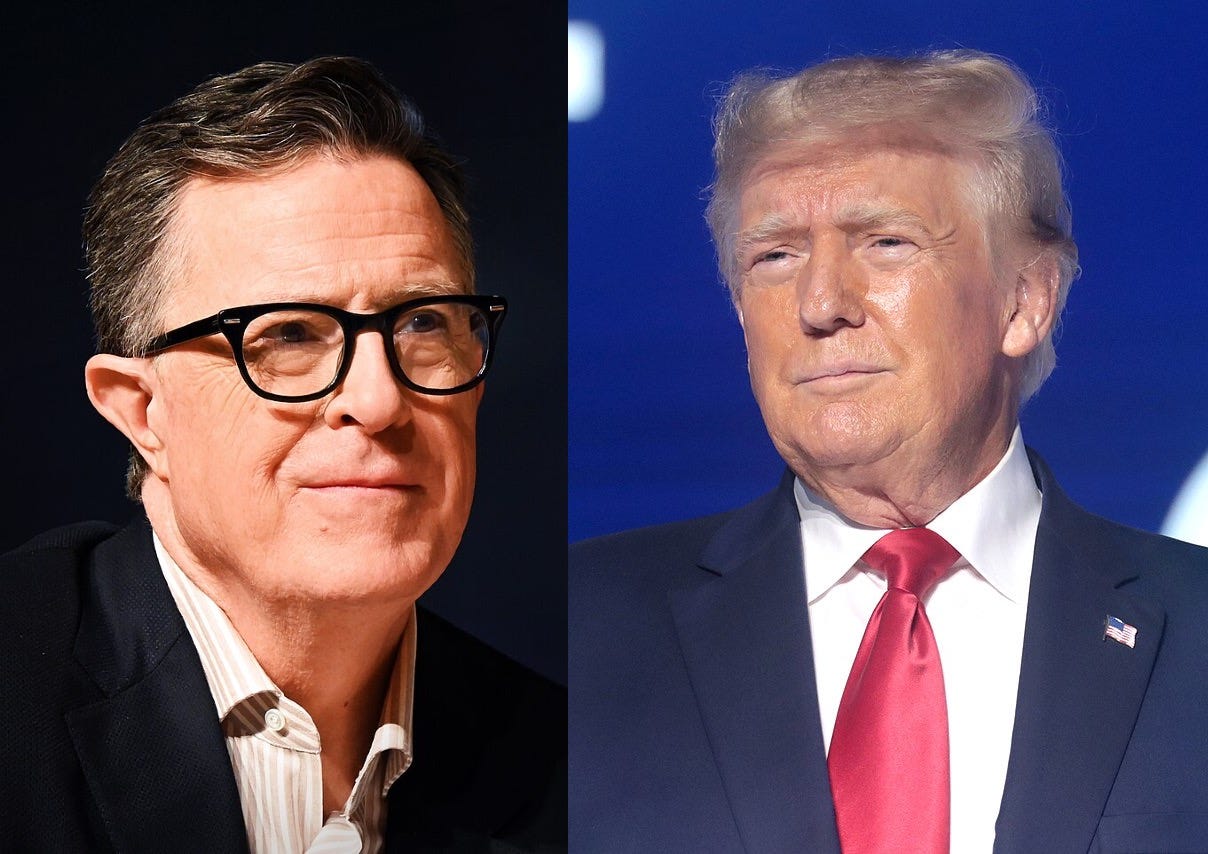
In 2005, the comedian Stephen Colbert coined the term “truthiness” to describe President George W. Bush’s obfuscations over the 2003 invasion of Iraq. Some 21 years later, truthiness doesn’t quite cover U.S. President Donald Trump’s constantly-shifting goals and false updates about the joint military operation with Israel against Iran. Iran is not only post-truth, but it is the first war conducted by the U.S. in a different reality.
At the start, Trump outlined a clear goal: regime change. In a February 28 video announcing strikes, Trump urged Iran’s people to “take over your government” after strikes end, adding that “America is backing you with overwhelming strength and devastating force.” Immediately, top U.S. officials began walking this back. On April 1, Trump gave his first primetime Oval Office address since the conflict began. He said, “Regime change was not our goal. We never said regime change, but regime change has occurred because of all of their original leaders’ death.”
But regime change hasn’t happened. The son of Iran’s supreme leader, Mojtaba Khamenei, was named as his father’s successor after he was killed in an Israeli airstrike on the first day of the war. In an April 1 social media post, Trump said that Iran had a “new regime president” who was “much less radical and much more reasonable.” However, Iran has had the same president, Masoud Pezeshkian, since before the war. Mojtaba Khamenei, Iran’s supreme leader, is considered a hardliner and seems to be in no mood for compromise given that his father, mother, wife, and son were all killed by the Israeli airstrike.
On the diplomatic front, Trump’s updates are not credible. On March 23, Trump called off an ultimatum to strike Iran’s power plants -- expiring that day -- claiming that negotiations with Iran were showing progress. Markets rose at the news. Iran immediately denied it. Trump was likely referring to messages passed indirectly between the U.S. and Iran via Turkey, Egypt, and Pakistan. On April 1, Trump claimed on social media that Iran’s supposed “new regime president” had asked for a cease-fire, which Iran again denied. Later that day in the Oval Office address, Trump made no mention of negotiations. On April 3, mediators said the efforts to reach a cease-fire between the U.S. and Iran had reached a dead end.
The reality is that Trump, much more than Iran, is likely looking for a quick exit. In the U.S., Iran’s seizure of the Strait of Hormuz -- where about 20 percent of the world’s oil flows through -- has caused average gas prices to rise to over $4/gallon, signaling trouble for Republicans ahead of midterm elections in November. According to the Wall Street Journal, Trump has told aides that he is willing to end the war without reopening the narrow strait.
Trump has claimed that high oil prices are a good thing for the U.S. because the country “make[s] a lot of money” when prices rise. He also has claimed that the U.S. doesn’t “need” the oil that transits the strait because most of it is bound for Europe and Asia. These claims are dishonest: high oil prices may be good for oil companies, but not for Americans driving to work or taking their kids to school. Even if most of the U.S.’ oil comes from elsewhere, oil is bought and sold globally, so a supply crunch in one region drives up the world price.
In one sense, it shouldn’t be surprising that Trump has carried out the war by seeming to invent facts on the spot, which Trump has done before during grave catastrophes. In April 2020, he suggested in a nationally-televised briefing with health officials that injecting bleach would cure coronavirus, which was then raging through the U.S. population without a cure. But the U.S. president has awesome -- and almost unlimited -- powers as the commander-in-chief of the world’s most powerful military, so it is astonishing to see a very real kinetic campaign carried out with statements that have no bearing in reality.
The most startling example of this has been Trump’s false claim that Iran -- not the U.S. -- bombed its own girls’ school on the first day of the war, killing some 175 people, many of them children. When asked by a reporter why nobody else in the administration echoed his claim, he said: “Because I just don’t know enough about it. I think it’s something that I was told is under investigation.”
Part of Trump’s disconnect with reality stems from the fact that advisers aren’t giving Trump a complete picture of the war. On March 25, NBC News reported that the U.S. president has been watching a daily two-minute video compiled by military officials of the biggest, most successful strikes of “stuff blowing up” over the previous 48 hours. Trump tends not to handle bad news well: on social media, he has raged at European nations for not reopening the Strait of Hormuz after they declined to help in a war that they weren’t consulted on prior.
On April 3, Trump posted, “With a little more time, we can easily OPEN THE HORMUZ STRAIT, TAKE THE OIL, & MAKE A FORTUNE. IT WOULD BE A ‘GUSHER’ FOR THE WORLD???” Only a few days earlier, Trump had told other countries to “get your own oil.” Again, it seemed unlikely that this was less a policy change, and more the ramblings of a 79-year-old president who has stumbled into a self-imposed crisis that he cannot evade.