A Fly on the Wall to Russia's Fascist Indoctrination
The Oscar-nominated documentary, "Mr. Nobody Against Putin," offers a seldom-seen look into how Russian schools propagandize children

A few weeks ago, I was talking with another journalist about why I have mostly stopped writing about Russia. I haven’t felt safe going there since the start of the full-scale invasion of Ukraine in 2022, and wartime censorship makes it practically impossible (and dangerous) to gauge what people think and feel.
The documentary “Mr. Nobody Against Putin,” nominated for the Best Documentary Oscar, provides a window into Russia’s descent into fascism that no journalist could have ever obtained. The film, directed by Copenhagen-based American documentary filmmaker David Borenstein, follows Pavel Talankin (pictured below), the events coordinator and videographer for a school in the town of Karabash, a poor mining town in the Ural Mountains. Talankin is able to freely document the government-mandated patriotic events of the school because the state requires the school to upload footage of these displays to an online database to prove compliance. Talankin, who is opposed to the war, initially quits his job because he doesn’t want to be an accomplice for the state’s propaganda machine; however, he gets in touch with Borenstein, decides to save the footage for an undercover-style documentary, and rescinds his resignation. His camera captures children forced to march in formation, veterans from the brutal paramilitary organization Wagner speaking to young kids, and pupils taught how life in Europe has become terrible because of Western sanctions and why Russia was right to annex Crimea.
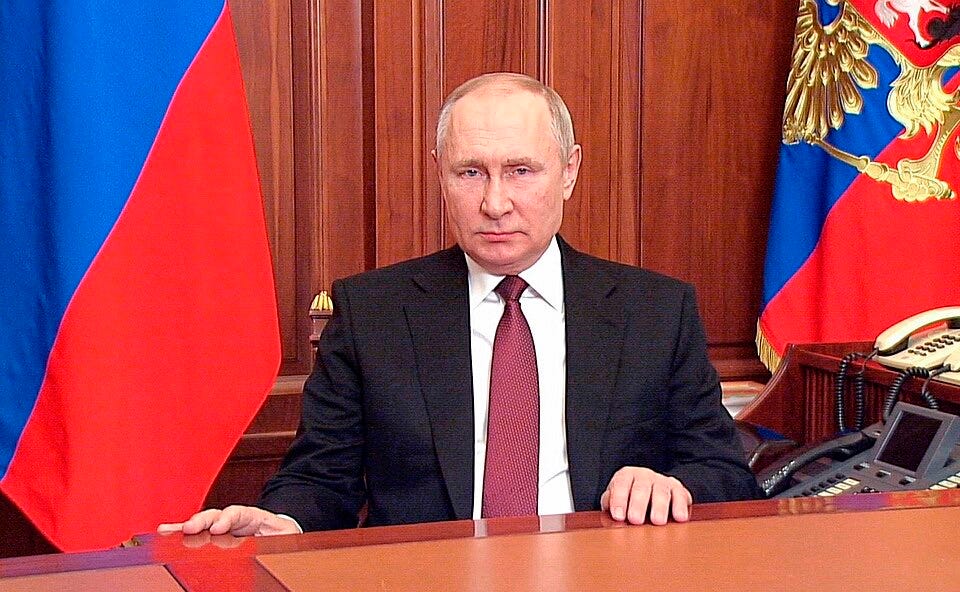
Russian leader Vladimir Putin has made teachers central to the war effort; in 2023, he approvingly cited a purported Bismarck quote that “wars are won not by generals but by teachers and priests.” The most interesting focus of Talankin’s camera is on his fellow educators: Talankin’s foil is the school’s jingoistic history teacher, Pavel Abdulmanov. In one chilling scene, Talankin asks Abdulmanov which figures from history he would have liked to have met, and he rattles off a list of Soviet sadists including Lavrentiy Beria, who served as head of the secret police under Stalin, oversaw the deportation and killing of millions in the Gulag system, and raped dozens of women in his spare time. It hardly comes as a surprise when Abdulmanov wins a luxury apartment (by European standards, a middle-class apartment) in the center of town for being the “teacher of the year.”
Yet, teaching is one of the few stable jobs in this poor town and a lot of his other colleagues treat the mandated indoctrination like checking a box. For example, while reading a script for one of the Kremlin’s patriotic lessons about the war in Ukraine, a teacher repeatedly struggles to say the word “demilitarization.”
Earlier this month, British intelligence estimated that Russia has suffered about 1.2 million casualties (wounded and dead) in the war; Talankin provides a rare glimpse into their grieving family members. In his narration, Talankin notes how he has barely seen any men wounded from the war; it seems like Russian authorities haven’t allowed them to return home. Many Karabash residents lose brothers and sons. Talankin’s student, Masha, ultimately loses her brother, and while she holds it together for the camera, there is a wall of unspoken grief on her face. Talankin also goes to the funeral of a dead soldier from the town, Artem. It’s too dangerous to film there, but in a particularly devastating scene, he plays the audio of the service as Artem’s mother wails in grief.
Talankin doesn’t hide his antiwar views, and things start getting dangerous for him. After a faculty meeting where the teachers are chewed out for the high rates of failing students, he tells colleagues: “the reason they are failing is all the bullshit…’Go, Russia! Hooray for nuclear weapons!’ is all we have here now.” Eventually, he spots a police car outside the window of his apartment. With the help of the filmmakers, in 2024, he fled Russia with his footage.
In “Mr. Nobody Against Putin,” most Russians go along with Putin’s war without really thinking much about it, but also without much enthusiasm. Sure, there are figures like the history teacher Abdulmanov who are true believers. But a lot of guys in Karabash go to war because the money’s good, their jobs are boring, and ultimately, it’s the path of least resistance. At goodbye parties, their friends say they will come home in a year, but they come home in body bags. Figures like Talankin who actually think for themselves and take action against the war are rare, but they inevitably have to flee, leaving behind a dwindling group of people who have acquiesced to fascism to eke out an ordinary life.
You are reading Public Sphere, an independent publication which is 100% funded by readers just like you who choose to become paid subscribers. I do not have a paywall today. You can read this site for a week or a month or six months, to see if you like it. If you do—if you think this is a worthwhile place, and you would like to help it survive—I ask that you take a moment to become a paid subscriber yourself.
If you found this post useful, you can use the buttons below to share it:


